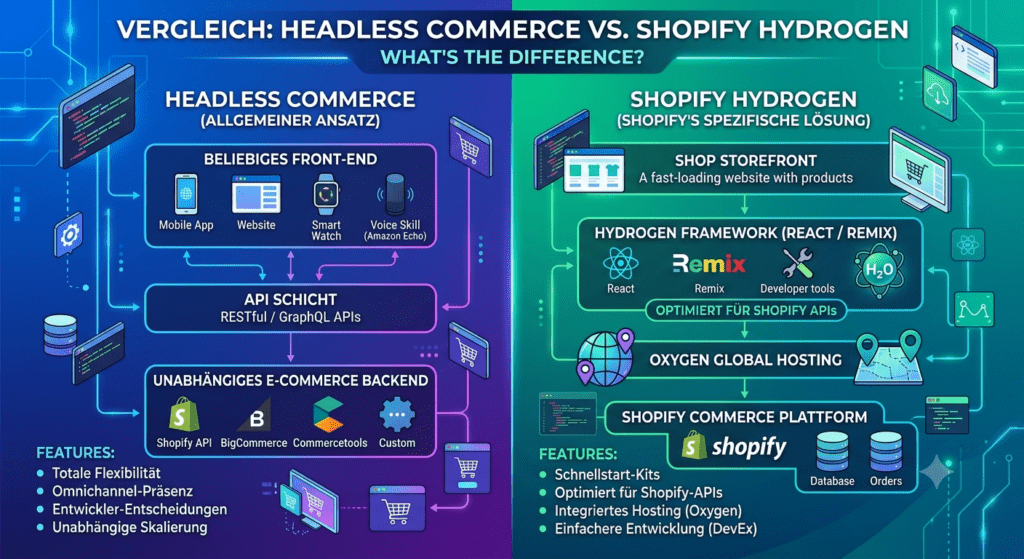

If you are planning to build a modern Shopify store, you may have come across two terms: Shopify Hydrogen and Headless Commerce.
Although they are closely related, they are not exactly the same thing.
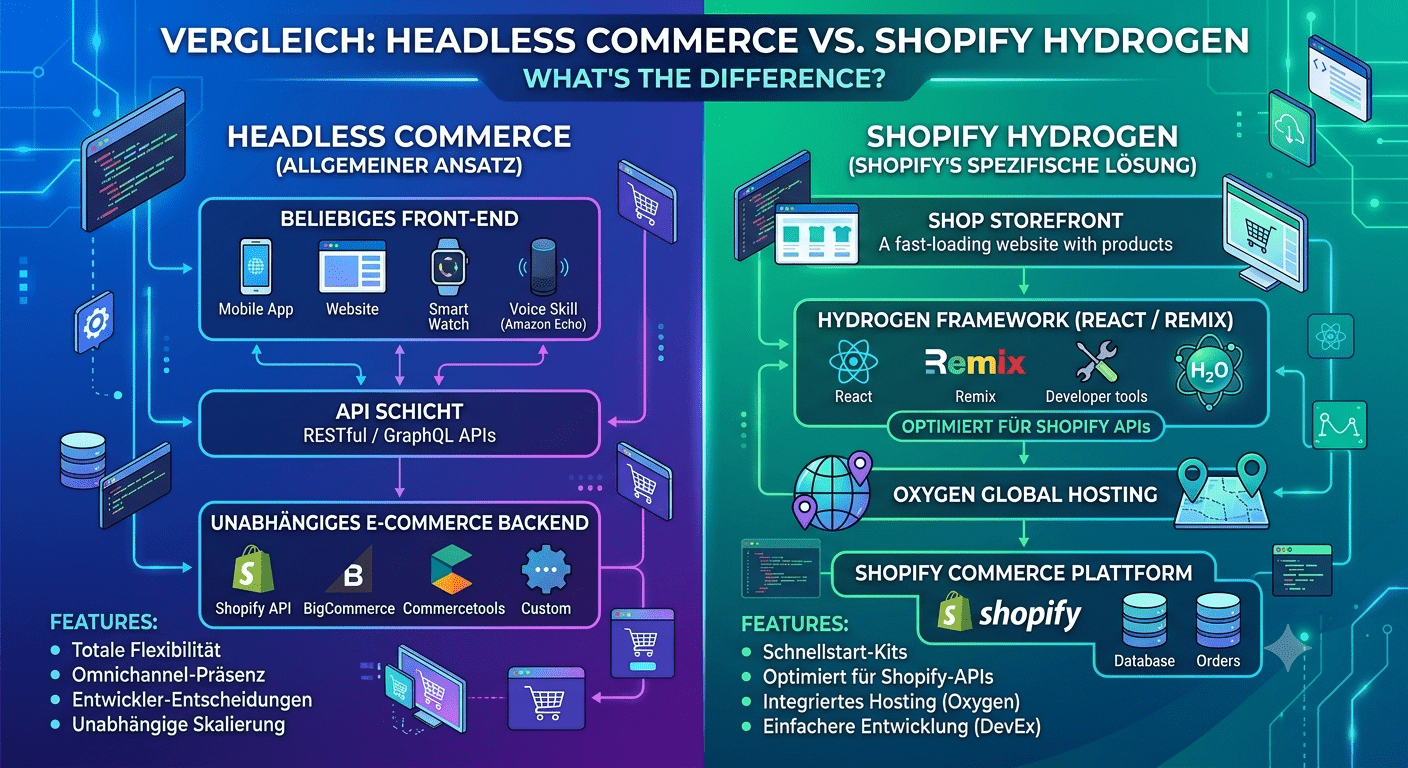
In simple terms, Headless Commerce is an architecture, while Shopify Hydrogen is Shopify’s framework for building a headless storefront.
Understanding the difference can help you choose the right technology for your ecommerce project.
What Is Headless Commerce?
Headless commerce means separating the frontend of an ecommerce website from the backend commerce platform.
In a traditional Shopify store, Shopify manages both:
- Storefront
- Products
- Cart
- Checkout
- Orders
- Customer data
- Ecommerce functionality
With a headless setup, the frontend can be built using technologies such as:
- React
- Next.js
- Vue
- Nuxt
- Hydrogen
- Other JavaScript frameworks
The frontend communicates with Shopify through APIs.
For example:
Customer → Custom Frontend → Shopify API → Shopify Backend
This gives developers much more control over the user experience and website architecture.
What Is Shopify Hydrogen?
Shopify Hydrogen is Shopify’s framework for creating custom storefronts.
Hydrogen is built around React and Shopify’s commerce infrastructure. It is designed specifically for creating fast, customizable Shopify storefronts.
A typical Hydrogen setup looks like:
Hydrogen + React → Shopify Storefront API → Shopify Commerce
Hydrogen can be used to build highly customized ecommerce experiences while continuing to use Shopify for important commerce functionality.
Shopify Hydrogen vs Headless Commerce
The biggest difference is simple:
| Headless Commerce | Shopify Hydrogen |
|---|---|
| An ecommerce architecture | A Shopify-specific storefront framework |
| Can use different frontend technologies | Built with React |
| Can work with different commerce backends | Designed specifically for Shopify |
| More technology choices | Shopify-focused development |
| Requires choosing a frontend framework | Provides a framework for Shopify storefront development |
So, Hydrogen is one way to implement a headless Shopify storefront.
Why Choose Headless Shopify?
A headless Shopify store can provide more freedom than a traditional theme-based store.
1. Complete Frontend Control
Developers can create custom layouts, animations, navigation, product experiences and interactions without being limited by a Shopify theme.
2. Custom User Experience
Headless architecture is useful when an ecommerce business requires a unique shopping experience that is difficult to achieve with a standard Shopify theme.
For example:
- Custom product configurators
- Interactive product pages
- Advanced filtering
- Custom navigation
- Personalized shopping experiences
- Interactive animations
- Custom mobile-first interfaces
3. Modern Web Technologies
A headless storefront can use modern frontend technologies such as React and Next.js.
This can make it easier for development teams already working with modern JavaScript frameworks.
4. Scalability
The frontend and commerce backend are separated, allowing teams to develop and evolve the customer-facing experience independently from the commerce infrastructure.
Why Choose Shopify Hydrogen?
Hydrogen is particularly useful when your store is already based on Shopify and you want a highly customized storefront.
Instead of building the entire ecommerce system from scratch, you can continue using Shopify for commerce functionality while using Hydrogen to create the frontend.
This can reduce the need to develop ecommerce features such as:
- Product management
- Inventory
- Orders
- Payments
- Checkout
- Customer management
while giving developers greater control over the storefront.
Hydrogen vs Next.js for Shopify
Another common question is:
Should I use Shopify Hydrogen or Next.js?
Both can be used to create custom Shopify storefronts, but they take different approaches.
Shopify Hydrogen
Hydrogen is specifically designed for Shopify.
It provides Shopify-focused tools and integrations for building custom storefronts.
Next.js
Next.js is a general-purpose React framework.
It provides greater flexibility for projects where the Shopify store is only one part of a larger application.
For example, a business might need:
Corporate Website + Blog + Ecommerce + Customer Portal + Custom Application
In such cases, Next.js can provide a broader development environment.
Which One Should You Use?
The answer depends on your project requirements.
Choose Hydrogen when:
- Your ecommerce platform is Shopify
- You want a highly customized Shopify storefront
- Your team works with React
- You want Shopify-focused headless development
- You want to build a modern custom storefront
Consider Next.js when:
- You need a broader application architecture
- You already have a Next.js development team
- Your website contains more than ecommerce
- You need complex custom functionality outside Shopify
- You want more control over the overall application architecture
Is Headless Better Than a Shopify Theme?
Not necessarily.
Headless provides more flexibility, but it can also require more development work.
A traditional Shopify theme can be a better fit when:
- You need to launch quickly
- Your store requirements are straightforward
- You want lower development complexity
- Shopify’s theme features are sufficient
Headless becomes more interesting when the business requires a highly customized digital experience.
Final Thoughts
Headless Commerce and Shopify Hydrogen are not competing concepts.
Headless Commerce describes the architecture, while Shopify Hydrogen is a framework that can be used to build a headless Shopify storefront.
A simple way to remember it is:
Headless Commerce = Architecture
Hydrogen = Shopify’s framework for building a custom storefront
Before choosing a technology, consider your budget, development team, performance requirements, integrations and the level of customization your ecommerce business actually needs.